 By Mahbub Manik
Einstein said, “Imagination is more powerful than knowledge”. Human imaginations don’t have any limits. People play with imaginations and imaginations open the horizons of limitless unknowns. Now scientists are being playing with a project that envisioning the creating of the same environment like after the creation of universe. To do that the largest underground scientific complex is made expensing more than $10 billion. The project is titles as ‘The Large Hadron Collider-LHC’. Recently the world has heard lots and there is huge enthusiasm, talk and debate on this issue. Basically it is the output of the nature and desire of human beings to know unknowns. Mystery of the universe’s creation is always a matter to research, rethink and rediscover. Physicists have been working relentlessly around the world to unearth the mystery of the universe’s creation.
By Mahbub Manik
Einstein said, “Imagination is more powerful than knowledge”. Human imaginations don’t have any limits. People play with imaginations and imaginations open the horizons of limitless unknowns. Now scientists are being playing with a project that envisioning the creating of the same environment like after the creation of universe. To do that the largest underground scientific complex is made expensing more than $10 billion. The project is titles as ‘The Large Hadron Collider-LHC’. Recently the world has heard lots and there is huge enthusiasm, talk and debate on this issue. Basically it is the output of the nature and desire of human beings to know unknowns. Mystery of the universe’s creation is always a matter to research, rethink and rediscover. Physicists have been working relentlessly around the world to unearth the mystery of the universe’s creation.
 What is the Large Hadron Collider-LHC?The Large Hadron Collider- LHC is a gigantic scientific complex buried more than 300 feet underneath near Geneva, in Franco-Switz border. It is a particle accelerator used by physicists to study the smallest known particles – the fundamental building blocks of all things. It will revolutionize our understanding, from the minuscule world deep within atoms to the vastness of the Universe. The LHC is the largest machine in the world and the emptiest space in the Solar System.It’s the hottest spots in the galaxy, but even colder than outer space. It is considered as the biggest and most sophisticated detectors ever built. The most powerful supercomputer system in the world is made to control, monitor and preserve the data of it.
Why the LHC?
The Large Hadron Collider is designed to resolve some key questions in particle physics. It may achieve some unexpected results that no one ever thought of it. There are some key issues in below that are the main issues of creating LHC.
Secrets of Big Bang
We all heard about the theory of ‘Big Bang’. The Big Bang model says the universe expanded from an extremely dense and hot state and continues to expand till today. But human minds have always wondered about the environment during the Big Bang and after that. What was matter like within the first second of the Universe’s life? The Collider will recreate the conditions of less than a millionth of a second after the Big Bang, when there was a hot "soup" of tiny particles called quarks and gluons.
Gravity no gravity
There is another model called as ‘The Standard Model’ of particle physics. The Standard Model of particle physics is a theory that describes three of the four known fundamental interactions among the elementary particles that make up all matter. But the model has not well accepted as there is no explanation of gravity and there are some missing links in the model.
There is another term ‘Higgs Boson’. The Higgs boson is a hypothetical massive scalar elementary particle predicted to exist by the Standard Model of particle physics. It is predicted that during the Big Bang the ‘Higgs Boson’ particle existed. But no experiment could prove it.
Invisible mass
Again we may ask, what is mass? What is the origin of mass? Why do tiny particles weigh the amount they do? Why do some particles have no mass at all? At present, there are no established answers to these questions.
There is an invisible problem. What is 96% of the universe made of?Everything we see in the Universe, from an ant to a galaxy, is made up of ordinary particles. These are collectively referred to as matter, forming 4% of the Universe. Dark matter and dark energy are believed to make up the remaining proportion, but they are incredibly difficult to detect and study, other than through the gravitational forces they exert. Investigating the nature of dark matter and dark energy is one of the biggest challenges today in the fields of particle physics and cosmology.
Matter vs Antimatter
We may think about matter. But do we ever think on ‘antimatter’? Why is there no more antimatter? We live in a world of matter – everything in the Universe, including ourselves, is made of matter. Antimatter is like a twin version of matter, but with opposite electric charge. At the birth of the Universe, equal amounts of matter and antimatter should have been produced in the Big Bang. But when matter and antimatter particles meet, they annihilate each other, transforming into energy. Somehow, a tiny fraction of matter must have survived to form the Universe we live in today, with hardly any antimatter left. Why does Nature appear to have this bias for matter over antimatter?
Extra Dimensions
Do extra dimensions of space really exist? From Einstein we know about the three dimensions of space. But the String theory implies that there are additional spatial dimensions yet to be observed.

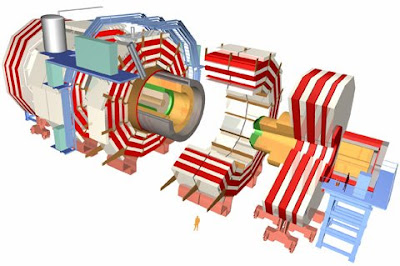 How the LHC works
The LHC, the world’s largest and most powerful particle accelerator is the latest addition to CERN’s accelerator complex. It mainly consists of a 27 km ring of superconducting magnets with a number of accelerating structures to boost the energy of the particles along the way.Inside the accelerator, two beams of particles travel at close to the speed of light with very high energies before colliding with one another. The beams travel in opposite directions in separate beam pipes – two tubes kept at ultrahigh vacuum. They are guided around the accelerator ring by a strong magnetic field, achieved using superconducting electromagnets. These are built from coils of special electric cable that operates in a superconducting state, efficiently conducting electricity without resistance or loss of energy. This requires chilling the magnets to about 271°C – a temperature colder than outer space! For this reason, much of the accelerator is connected to a distribution system of liquid helium, which cools the magnets, as well as to other supply services.Thousands of magnets of different varieties and sizes are used to direct the beams around the accelerator. These include 1232 dipole magnets of 15 m length which are used to bend the beams, and 392 quadrupole magnets, each 5–7 m long, to focus the beams. Just prior to collision, another type of magnet is used to 'squeeze' the particles closer together to increase the chances of collisions. The particles are so tiny that the task of making them collide is akin to firing needles from two positions 10 km apart with such precision that they meet halfway!All the controls for the accelerator, its services and technical infrastructure are housed under one roof at the CERN Control Centre. From here, the beams inside the LHC will be made to collide at four locations around the accelerator ring, corresponding to the positions of the particle detectors.
 The LHC experiments
There are six experiments are running at the LHC. They are (1) ATLAS - A Toroidal LHC ApparatuS (2) CMS-Compact Muon Solenoid (3) ALICE -A Large Ion Collider Experiment (4) LHCb- Large Hadron Collider beauty (5) TOTEM- TOTal Elastic and diffractive cross section Measurement (6) LHCf - Large Hadron Collider forwardThe two large experiments ATLAS and CMS, are based on general-purpose detectors to analyse the myriad of particles produced by the collisions in the accelerator. They are designed to investigate the largest range of physics possible. Having two independently designed detectors is vital for cross-confirmation of any new discoveries made.Two medium-size experiments, ALICE and LHCb, have specialised detectors for analysing the LHC collisions in relation to specific phenomena.Two experiments, TOTEM and LHCf, are much smaller in size. They are designed to focus on ‘forward particles’ (protons or heavy ions). These are particles that just brush past each other as the beams collide, rather than meeting head-onThe ATLAS, CMS, ALICE and LHCb detectors are installed in four huge underground caverns located around the ring of the LHC. The detectors used by the TOTEM experiment are positioned near the CMS detector, whereas those used by LHCf are near the ATLAS detector.
 LHC Computing Grid
The Large Hadron Collider will produce roughly 15 petabytes (15 million gigabytes) of data annually – enough to fill more than 1.7 million dual-layer DVDs a year! Thousands of scientists around the world want to access and analyse this data, so CERN is collaborating with institutions in 33 different countries to operate a distributed computing and data storage infrastructure: the LHC Computing Grid (LCG).Data from the LHC experiments is distributed around the globe, with a primary backup recorded on tape at CERN. After initial processing, this data is distributed to eleven large computer centres – in Canada, France, Germany, Italy, the Netherlands, the Nordic countries, Spain, Taipei, the UK, and two sites in the USA – with sufficient storage capacity for a large fraction of the data, and with round-the-clock support for the computing grid.These so-called “Tier-1” centres make the data available to over 120 “Tier-2” centres for specific analysis tasks. Individual scientists can then access the LHC data from their home country, using local computer clusters or even individual PCs.
9 … 3 ... 2 ... ha ha … 1...
The first beams were circulated through the Collider on 10 September 2008, and the first high-energy collisions are planned to take place after the LHC is officially unveiled on 21 October. The experiments could generate enough data to make a discovery by 2009, experts say.
Newage
Nothing could stop human being to think further and it’s the secret of existence of this universe. This experiment will lead further the movement of human knowledge. It will definitely open a new road of imagination. "When Columbus sails west, he thought he was going to find something. He didn't find what he thought he was going to find, but he did find something interesting," said Lykken, who works on the Compact Muon Solenoid, one of six experiments inside the collider complex. Lykken said right thing, some thing new will come soon, just wait!


 dynamic leadership and talented planning, RAB could capture JMB terrorist kingpins. Later all terrorists were sentenced to death. From the beginning RAB emerged as an efficient force and sucessfully transformed Dhaka as a zero crime city. Colonel Gulzar Uddin Ahmed played an important role. The whole nation mourns for him. May Allah bless him. Salute to this great soldier.


 Update … February’s BDR Revolt
One. No curfew ...
Two. Dioalogue between Government and BDR going on
Three. Number of caualties isn't reavealed
Update … February’s BDR Revolt
One. No curfew ...
Two. Dioalogue between Government and BDR going on
Three. Number of caualties isn't reavealed

 Details:
Event Name: February’s BDR Revolt
Place: BDR Headquarter, Dhaka, Bangladesh
Starts: 7.00 am, Wednesday, February 25, 2009
Issues:
1. Evaluating their contribution to the nation building task
2. Increasing salary
3. Improving their over all conditions
4. Career advancement
Killed: Not Revealed, at least 1
Wounded: Not revealed, Many
Details:
Event Name: February’s BDR Revolt
Place: BDR Headquarter, Dhaka, Bangladesh
Starts: 7.00 am, Wednesday, February 25, 2009
Issues:
1. Evaluating their contribution to the nation building task
2. Increasing salary
3. Improving their over all conditions
4. Career advancement
Killed: Not Revealed, at least 1
Wounded: Not revealed, Many


 By Mahbub Manik
Einstein said, “Imagination is more powerful than knowledge”. Human imaginations don’t have any limits. People play with imaginations and imaginations open the horizons of limitless unknowns. Now scientists are being playing with a project that envisioning the creating of the same environment like after the creation of universe. To do that the largest underground scientific complex is made expensing more than $10 billion. The project is titles as ‘The Large Hadron Collider-LHC’. Recently the world has heard lots and there is huge enthusiasm, talk and debate on this issue. Basically it is the output of the nature and desire of human beings to know unknowns. Mystery of the universe’s creation is always a matter to research, rethink and rediscover. Physicists have been working relentlessly around the world to unearth the mystery of the universe’s creation.
By Mahbub Manik
Einstein said, “Imagination is more powerful than knowledge”. Human imaginations don’t have any limits. People play with imaginations and imaginations open the horizons of limitless unknowns. Now scientists are being playing with a project that envisioning the creating of the same environment like after the creation of universe. To do that the largest underground scientific complex is made expensing more than $10 billion. The project is titles as ‘The Large Hadron Collider-LHC’. Recently the world has heard lots and there is huge enthusiasm, talk and debate on this issue. Basically it is the output of the nature and desire of human beings to know unknowns. Mystery of the universe’s creation is always a matter to research, rethink and rediscover. Physicists have been working relentlessly around the world to unearth the mystery of the universe’s creation.
 What is the Large Hadron Collider-LHC?The Large Hadron Collider- LHC is a gigantic scientific complex buried more than 300 feet underneath near Geneva, in Franco-Switz border. It is a particle accelerator used by physicists to study the smallest known particles – the fundamental building blocks of all things. It will revolutionize our understanding, from the minuscule world deep within atoms to the vastness of the Universe. The LHC is the largest machine in the world and the emptiest space in the Solar System.It’s the hottest spots in the galaxy, but even colder than outer space. It is considered as the biggest and most sophisticated detectors ever built. The most powerful supercomputer system in the world is made to control, monitor and preserve the data of it.


 How the LHC works
 The LHC experiments
 LHC Computing Grid


